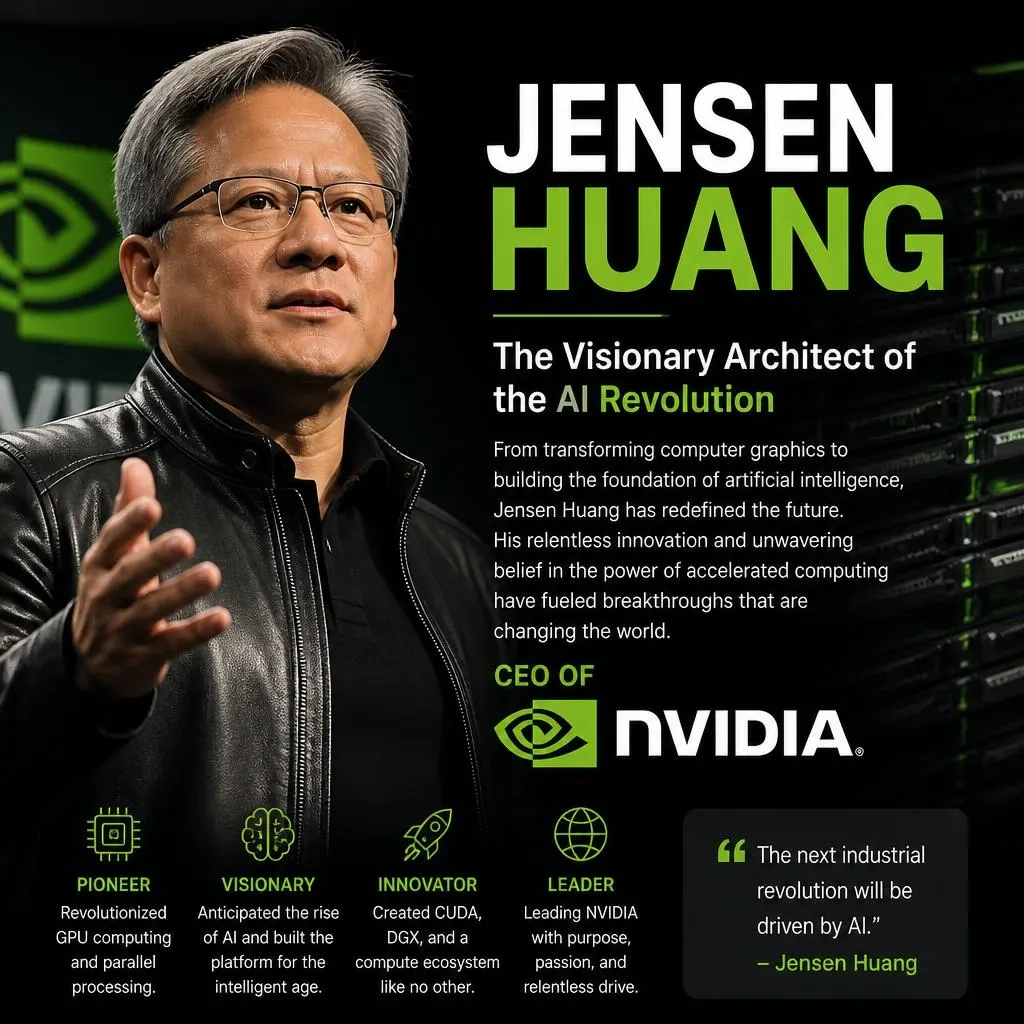



Jensen Huang: The Visionary Architect of the AI Revolution and CEO of Nvidia
In the modern technology ecosystem, few leaders have reshaped human industry as dramatically as Jen-Hsun “Jensen” Huang. As the co-founder, president, and Chief Executive Officer of Nvidia Corporation, Huang led a transformation that turned a niche graphics card startup into one of the most valuable tech enterprises in history. Known for his iconic black leather jackets, relentless work ethic, and uncanny foresight, Huang recognized early that accelerated computing and graphics processing units (GPUs) would power the next major paradigm shift in computing: Artificial Intelligence.
From his humble beginnings as an immigrant child working at a Denny’s diner to navigating multi-trillion-dollar market valuations and high-stakes global tech politics, Jensen Huang’s story is a masterclass in risk-taking, engineering mastery, and long-term vision.
1. Early Life and Educational Roots
Jensen Huang was born in Tainan, Taiwan, in February 1963. At the age of five, his family moved to Thailand, but amidst growing political instability in Southeast Asia, his parents decided to send Huang and his brother to live with relatives in the United States when he was just nine years old.
Key Formative Milestones:
- The Oneida Experience: Huang was sent to the Oneida Baptist Institute in Kentucky, a boarding school where he washed dishes after school and learned resilience alongside students from diverse backgrounds.
- Oregon Foundations: After his parents moved to Oregon, Huang attended Alohi High School in Beaverton, where he excelled academically and became a competitive table-tennis player.
- Academic Excellence: Huang earned his Bachelor of Science in Electrical Engineering (BSEE) from Oregon State University in 1984. He later pursued higher education while working in Silicon Valley, earning a Master of Science in Electrical Engineering (MSEE) from Stanford University in 1992.
Before founding Nvidia, Huang gained valuable hands-on experience in the semiconductor industry working as a microprocessor designer at AMD and later as a director of Core Logic at LSI Logic.
2. The Birth of Nvidia: A Denny’s Diner Vision
In 1993, at the age of 30, Jensen Huang met with two fellow engineers—Chris Malachowsky and Curtis Priem—at a Denny’s diner in San Jose, California. The trio recognized that the future of computing required accelerated hardware capable of rendering complex 3D graphics for computer games.
       [ 1993: Founded at Denny's ]
                     │
                     ▼
      [ 1999: Invented the GPU (GeForce 256) ]
                     │
                     ▼
       [ 2006: Launched CUDA Platform ]
                     │
                     ▼
 [ 2012–Present: Pivoted to AI, Deep Learning & Enterprise ]
Critical Early Breakthroughs
- The RIVA 128 (1997): After an initial commercial failure with the NV1 chip, Nvidia faced near-bankruptcy. Huang gambled the remaining company funds on the RIVA 128, a 3D graphics processor that became an instant commercial hit, selling over a million units in months.
- Inventing the GPU (1999): Nvidia went public on the NASDAQ in 1999 and launched the GeForce 256, marketed as the world’s first true Graphics Processing Unit (GPU). This innovation revolutionized the PC gaming industry.
3. The CUDA Gamble: Betting Everything on Parallel Computing
Perhaps the single most critical decision in Jensen Huang’s career came in 2006 with the release of CUDA (Compute Unified Device Architecture).
At the time, GPUs were primarily used to render pixels for video games. Huang envisioned a future where GPUs could be programmed like general-purpose CPUs to perform massive parallel processing—executing millions of mathematical calculations simultaneously.
- Wall Street Skepticism: For nearly a decade, Wall Street criticized Huang for spending billions of dollars in R&D to equip every Nvidia GPU with CUDA capabilities, which squeezed profit margins without an immediate commercial market.
- The AI Breakthrough (2012): The gamble paid off when researchers Alex Krizhevsky, Ilya Sutskever, and Geoffrey Hinton used CUDA-powered Nvidia GPUs to train AlexNet, a deep convolutional neural network that shattered image recognition records. This moment triggered the modern Deep Learning Revolution.
4. Driving the Artificial Intelligence Boom
When the generative AI boom arrived, Nvidia was not merely ready—it stood as the sole foundational infrastructure provider for the entire AI economy.
  NVIDIA HARDWARE & SOFTWARE ECOSYSTEM
 ┌─────────────────────────────────────────────────────────┐
 │               Generative AI Apps & LLMs                 │
 ├─────────────────────────────────────────────────────────┤
 │     CUDA Software Platform & NeMo Framework             │
 ├─────────────────────────────────────────────────────────┤
 │   Blackwell & Hopper GPUs (H100, B200, NVLink Architecture)│
 └─────────────────────────────────────────────────────────┘
Key Pillars of Nvidia’s AI Dominance:
- Hardware Monopoly: High-performance AI chips—from the groundbreaking A100 and H100 Hopper series to the Blackwell architecture—became the gold standard for training Large Language Models (LLMs) used by OpenAI, Microsoft, Google, Meta, and Amazon.
- Full-Stack Strategy: Huang transformed Nvidia from a chip vendor into a full-stack data center company, offering networking switches (Mellanox acquisition), proprietary server architectures (DGX SuperPODs), and optimized AI software libraries.
- Market Capitalization Milestones: Driven by global demand for AI infrastructure, Nvidia’s market capitalization surged past $3 trillion, briefly making it the world’s most valuable publicly traded company and elevating Jensen Huang’s personal net worth beyond $180 billion.
5. Leadership Philosophy, Culture, and Controversies
Jensen Huang’s management style is famously flat, demanding, and mission-driven. Unlike traditional tech CEOs who rely on rigid middle management, Huang directly manages up to 50 direct reports to maintain real-time visibility into operations.
Management & Culture Principles:
- First Principles Thinking: Huang encourages teams to build technologies by solving fundamental physics and engineering problems rather than reacting to short-term market trends.
- No Secret Meetings: He favors open organizational communications, often sending emails at all hours of the night to push project momentum.
- Long-Term Conviction: Huang is known for taking risks on projects that take 10 to 15 years to yield financial returns, such as autonomous vehicles (Nvidia DRIVE) and industrial digital twins (Nvidia Omniverse).
Navigating Global Geopolitics & Corporate Probes
As Nvidia grew into a key strategic player in international tech diplomacy, Huang faced immense pressure navigating US-China trade policies and export restrictions on advanced semiconductors.
In late 2026, Huang and Nvidia made headlines when the board initiated an independent internal investigation regarding security governance and personal conduct disclosures following foreign intelligence targeting reports. Despite these operational and personal pressures, Huang maintained his commitment to guiding the company’s long-term technical roadmap.
6. The Future Vision: Quantum, Robotics, and Omniverse
Jensen Huang shows no signs of slowing down his push toward the next frontiers of computing technology.
                   FUTURE TECH HORIZONS
                            │
       ┌────────────────────┼────────────────────┐
       ▼                    ▼                    ▼
[ Humanoid Robotics ] [ Industrial Twins ] [ Quantum Computing ]
 (Project GR00T)       (Nvidia Omniverse)    (CUDA-Q Platform)
- Physical AI & Humanoid Robotics: Huang believes the next wave of AI will be “Physical AI”—autonomous systems, robots, and self-driving cars that understand spatial mechanics and interact directly with the real world through platforms like Project GR00T.
- Industrial Digital Twins: Through Nvidia Omniverse, Huang is spearheading real-time 3D simulation, enabling global manufacturers to build virtual models of factories, climate patterns, and urban cities before building them physically.
- Quantum Acceleration: Nvidia continues to integrate classical GPU supercomputers with quantum processing units via its CUDA-Q platform to prepare for the quantum computing era.
Summary Timeline of Jensen Huang’s Legacy
| Year | Milestone |
| 1963 | Born in Tainan, Taiwan. |
| 1984 | Graduates from Oregon State University with a B.S. in Electrical Engineering. |
| 1993 | Co-founds Nvidia Corporation at a Denny’s diner in San Jose. |
| 1999 | Launches the GeForce 256, inventing the modern GPU; Nvidia goes public. |
| 2006 | Introduces the CUDA parallel computing architecture. |
| 2012 | Nvidia GPUs power the AlexNet AI breakthrough, kicking off the AI era. |
| 2023–2026 | Leads Nvidia into multi-trillion-dollar valuations as the primary engine of global AI. |